
OSINT Search Tools: Free vs Paid Options and the Coverage Gaps Between Them
Compare free and paid OSINT search tools, their monitoring, graph, and API capabilities, and the coverage gaps teams still need to solve.
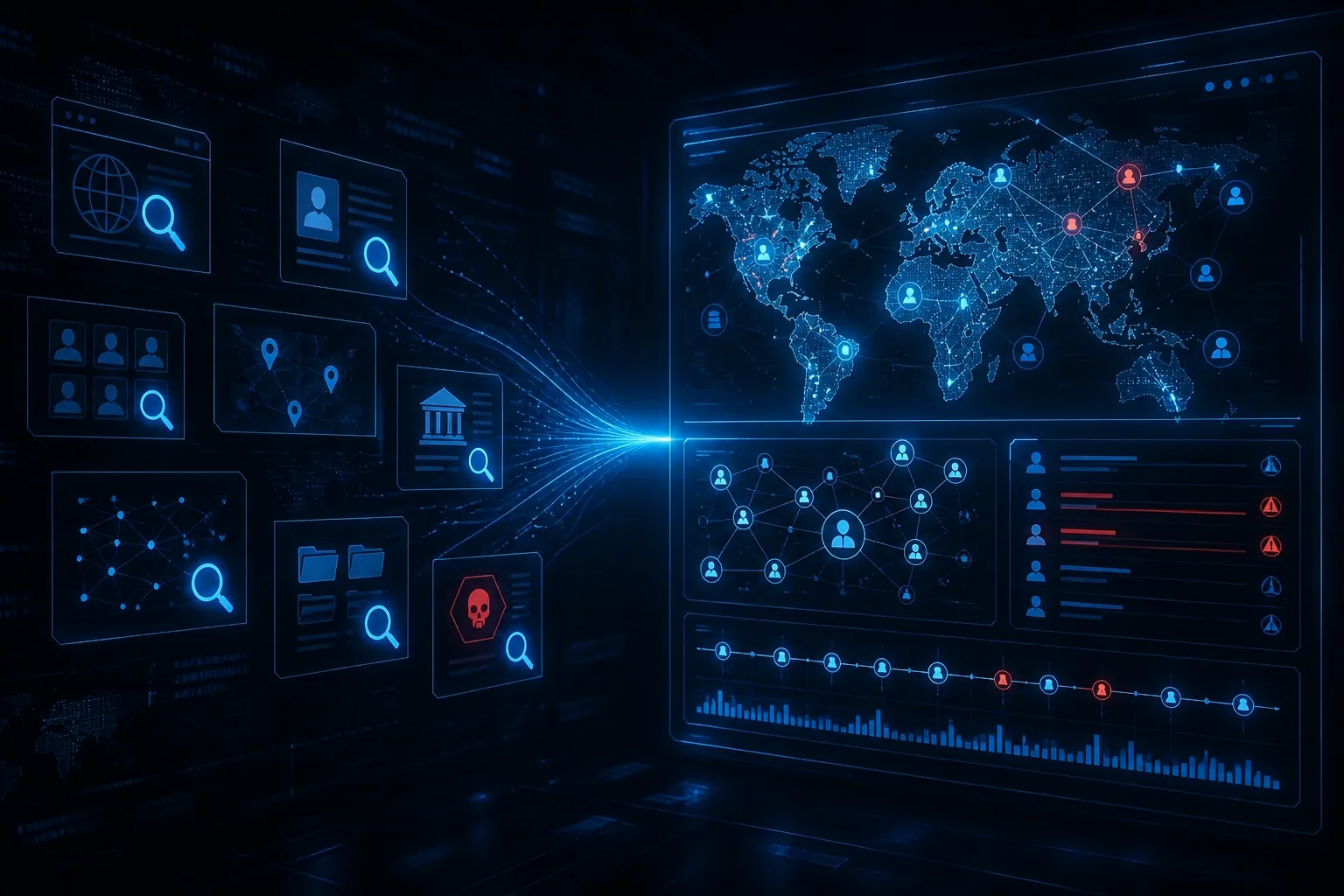
Most people start with free tools. Google operators, Shodan's free access, WHOIS lookups, and social media searches work well for one-off queries. But at some point, the gaps become impossible to ignore. You are juggling eight browser tabs, manually correlating results, and still missing context that would only surface if you could see all the signals at once.
This article maps the free and paid OSINT search tool landscape honestly: what each tier covers and where the structural gaps sit regardless of price. For adjacent comparisons, see our guides to the best OSINT aggregation tools in 2026 and Gotham-class platforms for smaller security teams.
Vendor capabilities, pricing, and links were reviewed against first-party product pages on August 25, 2026. Product packaging can change.
What Free OSINT Search Tools Actually Cover
Free tools are genuinely useful. The problem is not that they are weak; it is that they are narrow by design.
Search and Discovery
Google Search remains one of the most
powerful free OSINT surfaces available. Documented operators such as site:, filetype:, exact
quotes, exclusions, before:, and after: can surface indexed content that standard searches
miss. The limitation is freshness and depth: Google indexes what it crawls, not everything an
analyst may want to monitor.
Shodan offers free access with limited search capabilities. For basic internet-facing device discovery—open ports, banners, and exposed services—it is a useful starting point. Shodan's current plans expand query credits, monitoring, exports, and API capabilities, while its developer documentation covers programmatic and streaming access.
WHOIS and DNS tools such as DomainTools, MXToolbox, and SecurityTrails provide registration, DNS, and infrastructure context. Their public lookup experiences are useful for individual questions; broader history, automation, and monitoring depend on the provider and plan.
Social and Public Record Search
Social Searcher and username-enumeration tools can help find public references to a known identity. Coverage varies by platform, rate limits can be restrictive, and results are usually point-in-time rather than monitored.
Pipl appears in many older free-OSINT lists, but its current people-search and identity products are commercial. Treat it as a paid identity-data provider rather than a general free public-record search tool.
Archive.org's Wayback Machine is a public resource for historical web content. For retrieving archived versions of pages, it remains an essential complement to current search results.
Threat and Cyber Intelligence
VirusTotal provides file, URL, domain, and IP analysis across many security engines and datasets. Its public API is free within published rate and non-commercial-use limits; advanced commercial access is a separate product.
AlienVault OTX provides community-contributed threat indicators and pulses at no cost. It is valuable as a source, but analysts still need to assess provenance and correlate its indicators with other evidence.
Vulnerability databases such as CVE.org and the NIST National Vulnerability Database are public reference sources for known vulnerabilities. They describe vulnerabilities; they do not by themselves provide a complete operational monitoring workflow.
The Core Limitation of Free Tools
Most free tools require you to initiate every query. You visit the tool, ask a question, and get an answer. A few offer alerts or limited APIs, but they do not automatically create a unified, cross-domain picture for you. If an entity you track appears in three unrelated sources, you still need a workflow that detects and connects those observations.
For one-off investigations, that is workable. For ongoing monitoring of threat actors, geopolitical events, supply-chain partners, or competitive intelligence subjects, manual correlation breaks down quickly.
What Paid OSINT Platforms Cover (and What They Don't)
Paid tools generally improve depth, continuous monitoring, relationship visualization, or a combination of the three. The important question is whether those capabilities live in one product and entitlement or across separate modules and contracts.
Maltego: Strong on Graphs, Monitoring Is a Separate Product
Maltego Graph is a widely used visual link-analysis product with a rich ecosystem of Transforms and data connectors. It is designed for mapping connections between people, organizations, domains, IP addresses, and other entities during an investigation. Maltego's pricing page currently lists Basic, Entry, Professional, and Enterprise options; Professional is listed at €7,500 per year as of the review date above.
The core Graph workflow is analyst-directed: start with an entity, run Transforms, and pivot through the results. Maltego also offers Maltego Monitor for real-time social media monitoring, so it is inaccurate to describe the whole platform as pull-only. The practical distinction is that graph investigation and ongoing monitoring are separate product experiences rather than one general-purpose, cross-domain event feed.
Recorded Future: Deep Intelligence, Subscription-Based Access
Recorded Future combines threat data with research and analysis across cyber, third-party, identity, fraud, and geopolitical risk use cases. It is designed for established security and intelligence programs rather than casual, one-off search.
Recorded Future publishes extensive API documentation, but live requests require an active API subscription and token. Public list pricing is not published, so teams need to evaluate the specific modules, data access, API entitlements, and procurement process they are offered.
Flashpoint and ShadowDragon: Specialist, Sales-Led Platforms
Flashpoint combines threat intelligence, fraud, physical security, and national-security use cases. It also offers REST and Firehose APIs, so the relevant limitation is not the absence of an API. It is the sales-led access model and whether Flashpoint's specialist collections match the domains your team needs.
ShadowDragon supports investigator-led OSINT collection through products including SocialNet and continuous monitoring through Horizon Monitor. SocialNet's API documentation is public, while product access remains sales-led. Teams should evaluate source coverage, permitted use, delivery model, and integration scope against their specific workflow.
Palantir and Babel Street: Enterprise-Oriented Access
Palantir Gotham connects data, models, and operational workflows for defense and intelligence organizations. Palantir publishes platform API documentation, but Gotham is sold and deployed as an enterprise platform rather than a self-serve OSINT search tool.
Babel Street serves defense, intelligence, law enforcement, and enterprise risk teams with multilingual identity and risk intelligence. It launched agentic risk-intelligence workflows in May 2026 and advertises demo and trial paths, but product selection and procurement remain sales-led rather than a public API-key signup.
The Coverage Gaps That Neither Free Nor Paid Tools Fully Close
The market now offers more monitoring and API access than simple free-versus-paid comparisons suggest. Three practical integration gaps still deserve close scrutiny.
Gap 1: Real-Time Monitoring Across Diverse Signal Types
Free search tools rarely provide unified monitoring. Paid platforms may monitor deeply within their specialties, but teams still need to check whether cyber threats, geopolitical events, vessel movements, GPS interference, military posture, financial indicators, and physical events can appear in the same operating picture. Coverage and freshness vary by source even inside a single platform.
Gap 2: A Developer API as a First-Class Product
Many providers offer APIs; the meaningful differences are access, endpoint breadth, delivery options, documentation, and pricing. If you are building an intelligence-driven application, confirm that programmatic access covers the same data you see in the analyst interface and that the rate limits and entitlements fit production use.
Gap 3: Entity Relationship Context Alongside Live Events
Graph tools can map relationships, and monitoring tools can surface events. The harder workflow is moving from a new signal to the relevant people, organizations, infrastructure, and prior events without exporting data into a separate investigation. Evaluate whether that context is native, integrated through connectors, or left to your team to assemble.
Where Y2 Fits in This Picture
Y2 is built around these three workflow gaps. The Situation Room brings more than 100 feeds, sources, and datasets into a live, reactive dashboard across cyber, geopolitical, financial, and physical domains. Collection cadence is source-specific; the source catalog documents provenance and freshness rather than implying that every source updates continuously.
Entity and graph APIs place relationships between people, organizations, and events alongside the broader intelligence workspace. Projects keep graphs, reports, citations, source documents, and timelines together during an investigation.
The REST API is a documented product lane. Its OSINT endpoints cover normalized events, aircraft, vessels, military posture, GPS interference, cyber threats, critical-infrastructure indicators, financial indicators, prediction markets, country briefs, and source status. Additional endpoints cover entities, entity graphs, cyber graphs, incidents, signals, CVEs, threat actors, reports, and projects. Y2 also documents Python, TypeScript, and CLI clients, MCP access, and webhook delivery.
For analysts currently using Maltego for graphs, Shodan for infrastructure, VirusTotal for threat indicators, and news sources for geopolitical context, Y2 provides a place to correlate those classes of signal. For developers building intelligence applications, the API provides programmatic access without requiring every source pipeline to be maintained in-house.
Review the current Y2 plans and limits for self-serve pricing, API-key eligibility, rate limits, and feature availability.
How to Choose Based on Your Actual Workflow
If you run one-off investigations on a budget: Free tools such as Google operators, Shodan, VirusTotal, Archive.org, and public DNS services cover substantial ground. Add a graph product when visual relationship analysis becomes central to your work.
If you need continuous monitoring across multiple domains: Compare the actual signal types, source cadences, alerting paths, and retention offered by each platform. A cyber-specific product and a cross-domain situation-awareness product solve different problems.
If you are building an application: Evaluate documented endpoints, SDKs, authentication, rate limits, webhooks or streaming delivery, provenance, and commercial-use rights. An API's existence does not guarantee that it exposes the data or volume your application needs.
If you are a journalist, NGO researcher, or risk analyst: Prioritize source transparency, historical evidence, multilingual coverage, geopolitical and physical signals, and entity relationships. Cyber-centric depth may be less useful than broader context for these workflows.
FAQs
What are the best free OSINT search tools in 2026? Google with documented search operators, Shodan's free access, VirusTotal, AlienVault OTX, Archive.org, CVE.org, NVD, and public WHOIS or DNS lookup tools are useful starting points. Each covers a specific domain, so cross-source correlation remains the analyst's responsibility.
What is the main difference between free and paid OSINT tools? Free tools usually emphasize point-in-time lookup with tighter usage limits. Paid platforms add some combination of deeper datasets, monitoring, history, graph analysis, collaboration, and API entitlements. Exact packaging varies substantially by provider.
Why do some paid OSINT platforms make developer access difficult? Many platforms originated as analyst products and package APIs through sales-led subscriptions, modules, or data entitlements. Others, including Shodan, expose developer tooling more directly. Always evaluate the actual API contract rather than assuming that paid means programmable.
What coverage gaps exist even in paid OSINT platforms? Teams often still need to reconcile source breadth, varying freshness, API entitlements, and the handoff between live events and entity graphs. The gaps depend on the products and modules in the contract, not simply whether the platform is paid.
How does Maltego compare with platforms that provide live monitoring? Maltego Graph is centered on analyst-directed Transforms and link analysis. Maltego Monitor adds real-time social monitoring as a separate product. A broader live intelligence platform may cover more event types in one dashboard, while Maltego remains especially strong for targeted graph investigations.
Is Recorded Future worth the cost for a mid-size security team? That depends on the modules, API access, and intelligence domains the team needs. Recorded Future does not publish standard list pricing, so compare the quoted package with the team's actual workflows and with alternatives that offer transparent self-serve plans.
What should developers look for in an OSINT API? Look for documented endpoints covering the signals you need, SDK support, clear data models, source provenance, predictable rate limits, and webhook or streaming options. Confirm that the commercial terms and API entitlements support your expected production volume.
The free-versus-paid framing matters less than understanding what each tool was built to do. A free tool used well beats an expensive platform used for the wrong workflow. The real question is whether your current stack gives you a unified picture or just more tabs to manage.
If you are evaluating platforms that bring monitoring, graph context, and programmatic access together, explore Y2 and review the OSINT documentation.