
Your AI Agent's Memory Resets Every Session. That's a Workflow Problem, Not a Data Problem
You wire an agent up to a good data source, ask it a real question, and get a genuinely useful answer. Then two weeks later you ask something close to the same question, and the agent starts from zero.
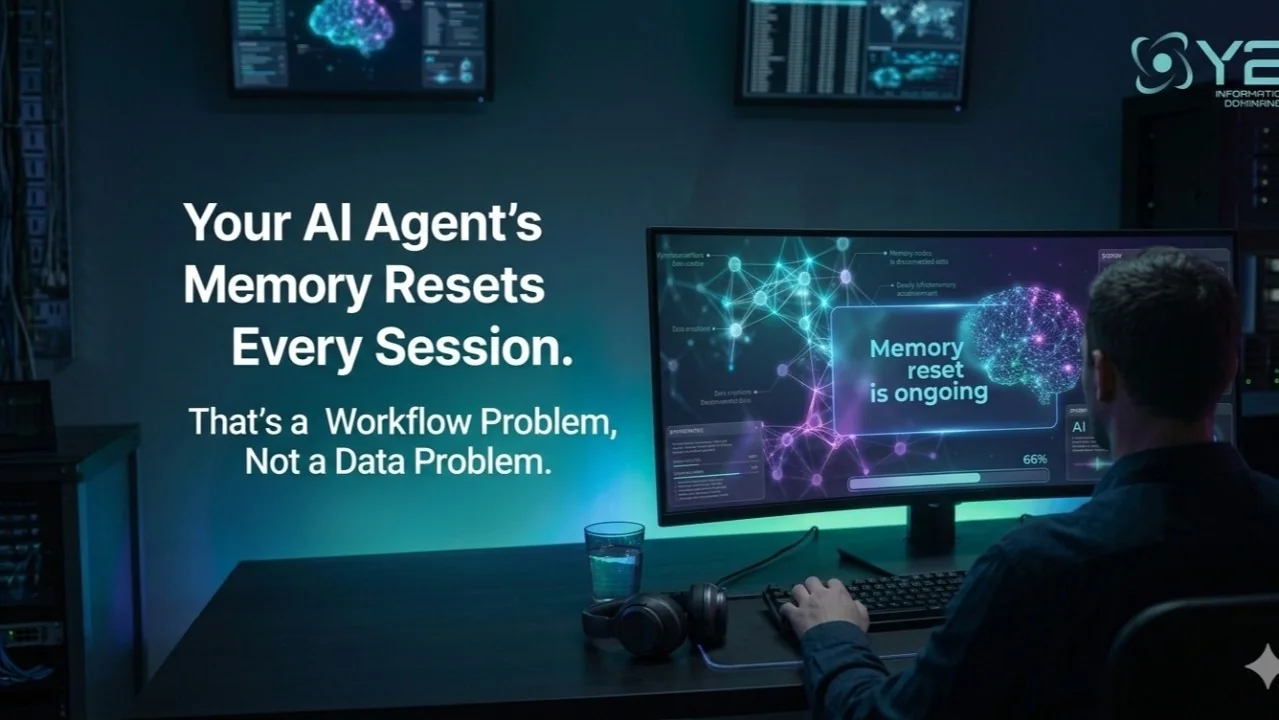
You wire an agent up to a good data source, ask it a real question, and get a genuinely useful answer. Then two weeks later you ask something close to the same question, and the agent starts from zero. No memory that it researched this before. No sense of what's changed. No trail of what it found last time that turned out to matter.
It's tempting to read that as a limitation of the model. It isn't. It's a consequence of how almost every "connect your agent to live data" integration is built: as a stateless function call. You call a tool, you get JSON back, the call ends, and nothing about it persists anywhere. That's a fine shape for a calculator. It's the wrong shape for anything you'd actually call monitoring.
TL;DR
- Most agent-to-data integrations are stateless: call a tool, get an answer, forget it happened. That's a data-source pattern, not a monitoring one.
- The gap gets more expensive as agents take on longer-running work, you keep re-paying the same research cost, and nothing tracks what actually changed.
- Persistent context needs three things a plain API call doesn't have: a standing object for the question, a place for evidence to accumulate and stay connected, and delivery that doesn't depend on someone remembering to ask again.
- That's the actual design behind Y2's Profiles and Project graph, a different shape of workflow, not just a bigger dataset.
- The practical test for any agent integration: ask it the same question again in a month. If nothing carries over, you've built a data source, not a monitoring system.
Why stateless is a design choice, not a limitation
Nothing about a language model requires this. The reason most integrations end up stateless is that it's the easiest thing to build: expose an endpoint, return a response, done. It works well in a demo, because a demo only ever asks one question. It works less well the moment you want an agent to track something, a risk, a market, a threat actor, a region, because tracking implies a "before" and an "after," and a stateless call has neither.
The cost compounds as agents take on more
This matters more every quarter, not less. As agents move from answering one-off questions to running longer, more autonomous workflows, the cost of forgetting stops being an inconvenience and starts being a real gap in the work:
- You re-ask a version of the same question weekly and re-pay the full research cost each time, because nothing was kept from the last pass.
- Nobody, human or agent can say what changed since last time, only what happens to be true right now.
- The evidence behind an answer isn't retained. You get a synthesized paragraph, not the sources and reasoning that produced it, so nothing compounds and nothing can be audited later.
What persistent context actually requires
"Give it memory" is the easy thing to say and the hard thing to build correctly. In practice it comes down to three concrete pieces, not one vague capability:
- A standing object for the question, not a chat log. A conversation history is not the same thing as a monitored topic. The question needs its own identity - a defined scope, a research cadence, a delivery path that persists independently of any one conversation.
- A place for evidence to accumulate and stay connected. Sources, entities, and relationships found this week need to link to what was found last week, building toward a graph rather than a pile of disconnected answers.
- Delivery that doesn't depend on someone remembering to ask. If a workflow only produces a result when a human happens to prompt it, it isn't monitoring anything - it's just a faster search bar.
How this shows up in Y2
This is the actual reasoning behind two specific pieces of Y2, not an afterthought bolted onto a data feed. A Profile is the standing object, a topic with a defined scope, cadence, and delivery path that keeps researching after the conversation that created it has ended. A Project is where the evidence accumulates, a knowledge graph of documents, chats, reports, entities, and relationships, with sources and provenance attached rather than flattened into a one-off answer.
We wrote up the mechanics in the Profiles and Projects documentation—worth reading if you want to see the difference between a stateless call and a Profile side by side, rather than just take the argument on faith.
The test to apply to any integration
This isn't really an argument for one product over another, it's a question worth asking about any agent-to-data integration, including ones we didn't build: if you ask it the same thing again in a month, does anything carry over, or does it start from zero?
A data source will always start from zero. That's not a flaw in the data source—it's just what it is. A workflow is the thing that doesn't, and it's worth being clear about which one you're actually building before you're three months into a project that quietly needed the other.